
Every backhoe loader comes with a maintenance schedule. Few operators follow it to the letter. This guide covers the Shanmon 388H service intervals exactly as laid out in the factory manual — every grease point, every fluid change, every filter replacement from the first 10-hour walk-around to the 2,000-hour major service. If you own or operate a 388H, bookmark this page. Your hour meter will catch up to it sooner than you think.
Why the 388H Maintenance Schedule Matters
The 388H works across loader, excavator, and grader functions in a single shift. That workload distributes wear across more systems than a standalone wheel loader or excavator — the front loader arms cycle hundreds of times a day, the backhoe boom pivots under constant digging loads, and the drivetrain shuttles between forward and reverse at every loading cycle. A missed grease point on the swing frame does not announce itself. It just wears the pins 30% faster until one day the machine develops slop in the backhoe articulation, and the repair bill lands on a spreadsheet instead of a daily checklist.
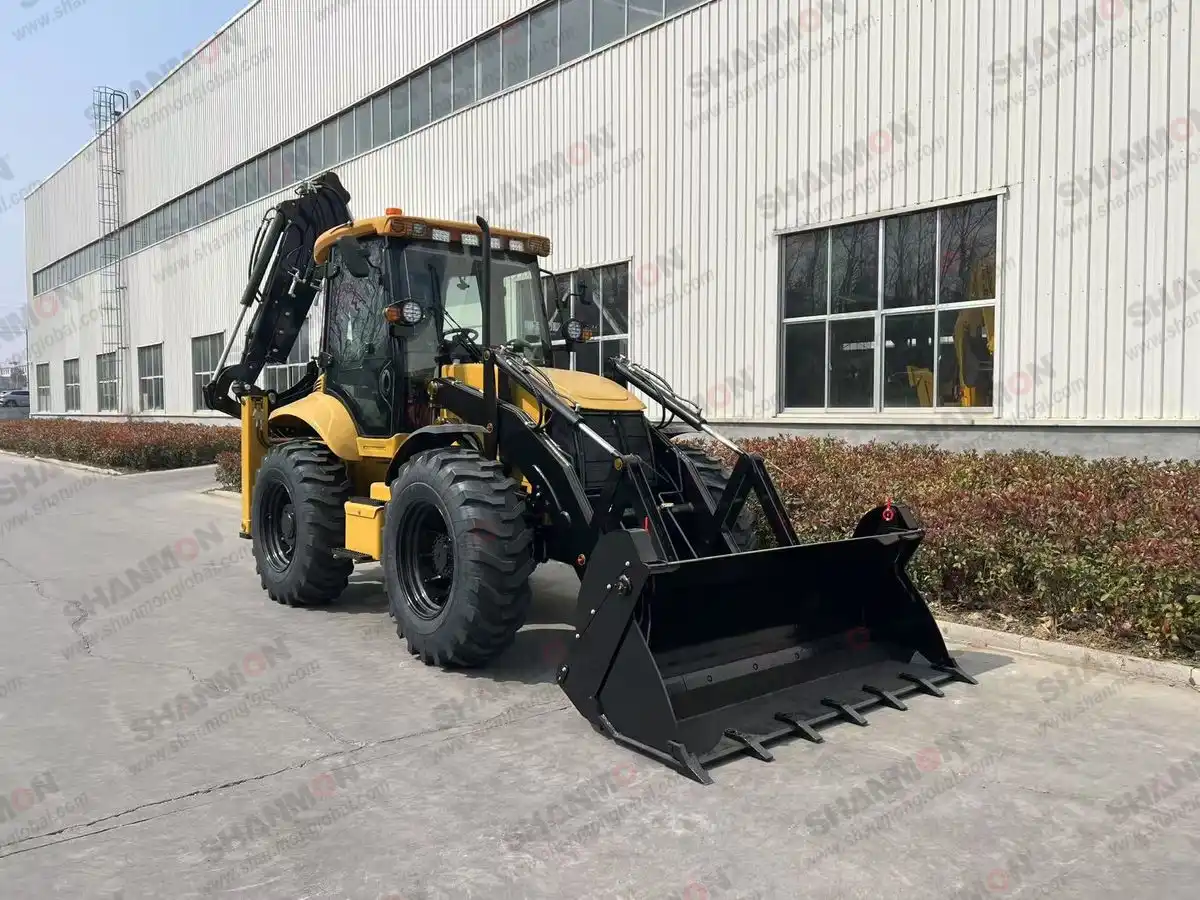
The Shanmon 388H service intervals are structured in six tiers. Each tier builds on the one below it. Skip a tier, and the next service interval inherits the accumulated wear.
388H Maintenance Schedule at a Glance
| Interval | Operating Hours | What to Do |
|---|---|---|
| Daily | Every 10 | Pre-start walk-around, fluid level check, drain water separator, check tire pressure |
| Weekly | Every 50 | Grease all 30+ lubrication points, check belt tension, inspect hydraulic hoses |
| Monthly | First 100 (break-in) | Engine oil & filter replacement, check all fasteners for torque |
| Semi-Annual | Every 500 | Engine oil & filter, fuel filter, air filter cleaning, check axle oil level |
| Annual | Every 1,000 | All 500-hour items plus coolant, transmission oil, hydraulic oil, axle oil change |
| Major | Every 2,000 | Complete fluid replacement — all oils, coolant, brake fluid — plus hose inspection and drivetrain evaluation |
Severe-Duty Adjustment
If your 388H works in any of these conditions, cut every interval by 20–30%:
- Continuous operation in ambient temperatures above 40°C (104°F)
- Heavy excavation in rocky or abrasive soil
- Extended idling between work cycles (common in municipal fleets)
- Dusty environments — quarries, demolition sites, dry-earth grading
- Operating in standing water or mud for more than 20% of shift time
In dusty conditions, the air filter element may need cleaning at 250 hours instead of 500. A clogged air filter does not just choke the engine — it increases fuel consumption and raises exhaust temperature, accelerating oil degradation.
Engine Oil: Grade, Capacity, and Change Interval
The 388H is powered by a Yuchai YC4A four-cylinder diesel engine producing 75 kW (102 HP) at 2,200 rpm. This is a turbocharged, water-cooled unit with a wet cylinder liner design — which means the oil works harder than in a naturally aspirated engine because it must also cool the piston crowns and turbocharger bearings.
Specification
| Oil Grade | API CF-4 or CH-4 (diesel engine oil) |
| Viscosity (warm climate, above -10°C) | SAE 15W-40 |
| Viscosity (cold climate, below -10°C) | SAE 10W-30 |
| Capacity (with filter) | Approximately 9–10 liters |
| Change Interval (standard) | 500 hours |
| Change Interval (break-in) | First 100 hours |
The first oil change at 100 hours is critical. During the break-in period, piston rings seat against the cylinder walls, generating microscopic metal particles. Leaving break-in oil past 100 hours circulates those particles through the bearing surfaces. After the first change, the 500-hour interval holds for normal conditions.
Hydraulic Oil: The Heart of the 388H
The 388H hydraulic system operates at 25 MPa through a Hengli variable-flow piston pump delivering 160 L/min. The system powers the loader lift and tilt cylinders, the backhoe boom, arm, and bucket cylinders, the swing mechanism, and the optional hydraulic quick coupler and hammer circuit. Clean hydraulic oil at the correct viscosity is the single largest factor in preventing pump cavitation and cylinder seal failure.
Specification
| Oil Grade | L-HM 46 (anti-wear hydraulic oil) or L-HV 46 (low-temperature variant) |
| ISO Viscosity Grade | ISO VG 46 |
| Capacity | Approximately 85 liters (system total) |
| Change Interval | 1,000 hours |
| Filter Replacement | Every 500 hours (return filter) |
In cold climates where ambient temperatures stay below -20°C for extended periods, switch to L-HV 46. The “V” grade contains viscosity index improvers that keep the oil fluid at low temperatures without sacrificing high-temperature film strength. A pump starved of oil on a cold morning will cavitate — and cavitation pits the pump’s wear plates within seconds.
Always check the hydraulic oil level with the loader bucket and backhoe in the travel position resting on the ground. Checking with the boom raised gives you a false low reading.
Transmission Oil: Powershift Demands Clean Fluid
The 388H uses an electro-hydraulic synchronized shuttle transmission delivering four forward and four reverse gears. The transmission shares a sump with the torque converter in some configurations, or runs independently depending on build spec. Either way, the oil handles both gear lubrication and hydraulic clutch pack engagement.
Specification
| Oil Grade | 8# transmission fluid or Dexron III equivalent |
| Capacity (transmission + torque converter) | Approximately 12–14 liters |
| Change Interval | 1,000 hours |
Delayed gear engagement or a noticeable shudder during directional shifts are early signs of degraded transmission oil. Do not wait for the service interval if these symptoms appear — change the oil and inspect the suction screen for clutch material.
Axle Oil: Front and Rear Differentials
The 388H runs a four-wheel-drive axle configuration with a centrally mounted differential on each axle. Depending on specification, axles may be domestic heavy-duty dry-type units or optional Carraro wet-disc axles. Both types require regular oil level checks because the planetary hub reductions at each wheel end run in their own oil bath, separate from the central differential.
Specification
| Oil Grade | GL-5 85W-90 (heavy-duty gear oil) |
| Capacity (each axle, central differential) | Approximately 6–8 liters |
| Capacity (each planetary hub, per wheel) | Approximately 0.5–0.8 liters |
| Change Interval | 1,000 hours |
| Level Check | Every 500 hours |
If your 388H works in waterlogged conditions or fords shallow streams, check the axle oil for emulsification — water enters through the breather when a hot axle housing hits cold water. Milky axle oil loses its extreme-pressure additives and must be changed immediately regardless of the hour meter.
Coolant: More Than Antifreeze
The 388H cooling system uses ethylene glycol-based coolant. Its job is not just freeze protection — it also raises the boiling point, prevents cavitation erosion on the cylinder liners, and inhibits corrosion across the cast-iron block, aluminum radiator, and steel piping.
Specification
| Type | Ethylene glycol, extended-life heavy-duty diesel coolant |
| Mixture Ratio | 50:50 coolant to water (standard); 60:40 for extreme cold below -35°C |
| Capacity | Approximately 19–21 liters |
| Change Interval | 1,000 hours or 2 years, whichever comes first |
Never mix different coolant colors or chemistries in the same system. Organic Acid Technology (OAT) coolants and conventional silicate-based coolants form sludge when combined. If you do not know what is in the radiator, drain and flush before refilling.
Grease Points: The 50-Hour Ritual
The 388H has over 30 grease nipples distributed across four zones. Every 50 operating hours — or weekly in a five-day operation — each one needs a pump or two of No. 2 lithium-based grease (NLGI Grade 2). In wet or muddy conditions, grease every 30 hours instead.
Loader Assembly
- Lift arm pivot pins (both sides, 2 points)
- Bucket tilt cylinder pins (both ends, 4 points)
- Lift cylinder pins (both ends, 4 points)
- Loader frame articulation pins (2 points)
Backhoe Assembly
- Boom pivot pin and bushings (2 points)
- Arm cylinder pins (both ends, 4 points)
- Bucket cylinder pins (both ends, 4 points)
- Bucket linkage pins (3 points)
- Extendable boom inner/outer slide pads (grease via dedicated nipples)
Swing Frame and Stabilizers
- Swing frame pivot pin — upper and lower (2 points)
- Swing cylinder pins (both ends, 4 points)
- Stabilizer leg pivot pins (both sides, 2 points)
- Stabilizer cylinder pins (both ends, 4 points)
Drivetrain
- Drive shaft universal joints (front and rear, 2–4 points depending on spec)
- Drive shaft slip joint (1 point, requires only 1–2 pumps — over-greasing locks the spline)
- Steering cylinder rod ends (4 points)
A battery-powered grease gun turns the 50-hour greasing from a 40-minute chore into a 15-minute routine. The single biggest reason operators skip grease points is time. Remove that excuse, and the machine’s pin-and-bushing life doubles.
Quick Reference: All Fluids at a Glance
| System | Fluid Type | Capacity | Change Every |
|---|---|---|---|
| Engine Oil | API CF-4/CH-4, SAE 15W-40 | ~9–10 L | 500 h (first at 100 h) |
| Hydraulic Oil | L-HM 46 (ISO VG 46) | ~85 L | 1,000 h |
| Transmission Oil | 8# or Dexron III | ~12–14 L | 1,000 h |
| Axle Oil (each) | GL-5 85W-90 | ~6–8 L per axle | 1,000 h |
| Planetary Hubs (each) | GL-5 85W-90 | ~0.5–0.8 L per hub | 1,000 h |
| Coolant | Ethylene glycol, 50:50 mix | ~19–21 L | 1,000 h or 2 years |
| Grease Points (30+) | NLGI #2 lithium grease | 1–2 pumps each | 50 h |
| Diesel Fuel | No. 0 or -10 diesel (seasonal) | ~120 L tank | Daily top-up |
Frequently Asked Questions
Can I use 10W-30 engine oil year-round?
In climates where ambient temperatures stay below 30°C (86°F), SAE 10W-30 is acceptable and may improve cold-start performance. In hot climates where summer temperatures exceed 35°C (95°F), stick with 15W-40. The heavier hot viscosity provides better film strength at the piston ring-cylinder wall interface under sustained load.
What happens if I skip the 100-hour break-in oil change?
The break-in period generates the highest concentration of wear metals the engine will ever see — primarily iron from the cylinder liners and copper from the main bearing shells. Continuing to circulate break-in oil past 100 hours sends those particles through the crankshaft and turbocharger bearings, accelerating early-life wear that does not announce itself until the 2,000-hour mark.
Can I use universal tractor hydraulic oil instead of L-HM 46?
Universal tractor oil (UTO) meets the needs of simple gear-and-piston hydraulic systems on agricultural tractors. The 388H’s variable-flow piston pump runs at higher pressure and tighter clearances than a tractor hydraulic system. UTO may foam under these conditions, and foamed oil does not lubricate. Use L-HM 46 anti-wear hydraulic oil unless the machine is operating in extreme cold, in which case L-HV 46 is the correct choice.
How do I know if grease has reached the pin bushing?
Pump until fresh grease emerges from the joint — either at the pin seal or from the edges of the bushing. If grease immediately exits from one side without filling the joint cavity, the pin seal on the opposite side may be damaged. A single pump that disappears into the joint without visible emergence may indicate a dry cavity — continue until you see the grease exit cleanly.
