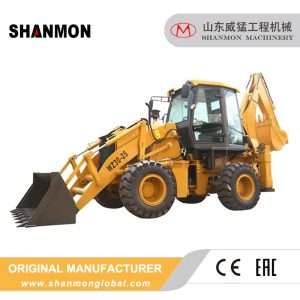
The Shanmon 388H vs JCB 4CX debate is one every backhoe buyer faces in 2026. The JCB 4CX is undoubtedly the industry benchmark — but with prices now at $125,000–$145,000, more contractors are asking whether a machine exists that delivers comparable performance at a fraction of the cost. Meanwhile, our Shanmon 388H has built a strong reputation across Russia, Southeast Asia, Africa, and the Middle East — markets where value matters more than brand prestige. In this comparison, we put both machines side by side across every metric that counts: engine specs, powertrain, hydraulics, operator comfort, total cost of ownership, and the practical decision framework for choosing between them.
Shanmon 388H vs JCB 4CX — Full Specification Comparison
Let’s start with the numbers. For a clear overview, here is how the two machines compare on core specifications:
| Specification | Shanmon 388H Max Configuration | JCB 4CX PRO (2025) |
|---|---|---|
| Engine Model | YUCHAI YC4A110Z-T23 (Cummins/Perkins/Weichai optional) | JCB Diesel 444 |
| Rated Power | 81 kW (110 hp) @ 2,200 rpm | 81 kW (109 hp) @ 2,200 rpm |
| Max Torque | 425 Nm | 440 Nm @ 1,300 rpm |
| Displacement | 4.8 L | 4.4–4.8 L |
| Emission Standard | Tier 2 / Tier 3 / Stage V | Tier 4 Final / Stage V |
| Transmission | Carraro TCB80 SPS automatic transmission, 4F + 4R, 4WD, 4WS | JCB SynchroShuttle / AutoShift, 4F + 4R (6F + 3R on Powershift) |
| Torque Converter | Carraro torque converter, pressure-oil circulation cooling | JCB torque converter with lock-up clutch |
| Axles | Carraro 26.32/26.43M — wet multi-disc brakes, self-adjusting | JCB heavy-duty axles — oil-immersed disc brakes |
| Steering Modes | 2WS / 4WS / Crab steer | 2WS / 4WS / Crab steer |
| Brake System | Full hydraulic, self-adjusting gap, multi-plate oil-bath, dual pedal | Oil-immersed multi-disc, dual pedal |
| Parking Brake | Independent, rear axle input shaft (holds on 1:3 slope) | Independent mechanical parking brake |
| Tires | 16.9-28 | 16.9-28 or 19.5L-24 |
| Travel Speed (max) | 38 km/h | 40 km/h |
| Operating Weight | 10,500 kg | ~8,000–8,600 kg |
| Loader Bucket Capacity | 1.2 m³ | 1.0–1.3 m³ |
| Rated Load (Loader) | 2,500 kg | ~2,300–2,600 kg |
| Max Dump Height (41°) | 2,964 mm | ~2,700–3,100 mm |
| Backhoe Bucket Capacity | 0.3 m³ | 0.2–0.3 m³ |
| Max Dig Depth (standard) | 4,150 mm | 4,270 mm (standard center-mount) |
| Max Dig Depth (extended) | 5,360 mm (telescopic boom) | 5,580–5,880 mm (ExtraDig extending dipper) |
| Max Dig Height (extended) | 6,680 mm | ~6,500–7,000 mm |
| Max Digging Force (backhoe) | 5,100 kgf | ~5,200–5,600 kgf |
| Max Reach at Ground Level | 5,345 mm | ~5,700–7,100 mm |
| Hydraulic Pump Type | Hengli variable-flow piston pump | JCB variable-flow piston pump |
| Hydraulic Pressure | 25 MPa | ~22–25 MPa |
| Control Valve | HUSCO manual-hydraulic / pilot control valve | JCB manual-hydraulic / pilot control valve |
| Ride Control | Danfoss Smooth Ride System (SRS) | JCB Smooth Ride System (SRS) |
| Pilot Valve / Steering | Danfoss pilot valve + Danfoss steering gear | JCB pilot controls + steering unit |
| Cab Certification | ROPS + FOPS certified, dual-door | ROPS + FOPS certified |
| A/C System | High-performance A/C, front + rear wipers | Climate control A/C, front + rear wipers |
| Seat | Adjustable suspension seat | Adjustable suspension seat, optional joystick pods |
| Hydraulic Tank | 130 L | ~100–130 L |
| Fuel Tank | 130 L | 160 L (42.5 gal) |
| Estimated New Price (USD) | $43,000–$63,000 (FOB China, varies by configuration) | $125,000–$145,000 |
Note: The 388H is available in 5 configurations (CE, Max, Super, Elite, Basic). The Max configuration shown here represents the highest-spec non-CE model with Carraro drivetrain, Hengli pump, and HUSCO valve. CE configuration adds Euro V emissions and CE certified cab.
Powertrain Deep-Dive: Carraro + Electro-Hydraulic vs JCB Proprietary
What the Spec Table Tells Us
388H Configuration Options
The 388H comes in five configurations to match different markets and budgets:
- 388H CE — Weichai Euro V 74kW, Carraro drivetrain, CE certified cab, 360° camera, engine hood silencer
- 388H Max — Carraro transmission + wet brake axles + Husco valve, 25 MPa, pilot controls
- 388H Super — Carraro wet brake axles + variable hydraulics, 20 MPa, pilot controls
- 388H Elite — Variable hydraulics + pilot controls, Chinese dry brake axles
- 388H Basic — Mechanical transmission + fixed hydraulics, most affordable option
The comparison table below uses the Max configuration as the reference model. Buyers targeting European or Middle Eastern markets should consider the CE version, which adds Euro V emissions compliance and CE certified components.
Our 388H: Carraro Axles with Electro-Hydraulic Transmission
When you dig into the Shanmon 388H vs JCB 4CX comparison, one of the most important things to understand about our 388H is that a European-Italian drivetrain core anchors the entire machine. Specifically, Carraro — the Italian company that supplies drivetrain components to John Deere, CNH (Case/New Holland), and AGCO — manufactures the axles. Notably, Carraro’s Italian R&D team specifically optimized the Carraro 26.32/26.43M axles for our 388H’s application, drawing on their extensive experience in the global backhoe loader market. Key design features include:
- High load capacity — purpose-built for the most demanding operating environments, with reliable gear geometry that extends service life and improves durability
- Large steering angle with optimized geometry — a Carraro standard feature that ensures precise steering, high maneuverability, and minimal tire wear
- Rational differential configuration — optimized to deliver the best traction on any surface condition, from loose soil to paved roads
- Full hydraulic service brake system — highly efficient, anti-heat-fade design. The self-adjusting gap, multi-plate oil-bath brakes significantly reduce maintenance workload and extend service life. Moreover, light brake pedal effort reduces operator fatigue. Additionally, dual brake pedals enable very small turning radius and controlled steering on slippery surfaces.
- Independent parking brake — located on the rear axle input shaft, holds the machine securely on a 1:3 slope.
Shifting Performance and Driving Experience
the Carraro TCB80 SPS automatic transmission — a proven Italian-built gearbox with 4WD and 4WS capability. In particular, we optimized the torque converter and clutch structure to prevent clutch slippage under heavy load, which improves overall load-bearing capacity and reliability. The electro-hydraulic joystick shifting delivers light-touch operation with minimal clutch engagement shock and vibration — consequently, you get a noticeably smoother driving experience than traditional mechanical or hydraulic shuttle shifters provide.
JCB 4CX: JCB Proprietary Powertrain
JCB powers the 4CX with its own Diesel 444 engine — a 4-cylinder turbocharged engine producing 81 kW (109 hp) and 440 Nm of torque. In fact, The manufacturer claims a 10–16% fuel consumption reduction over previous-generation models through advanced combustion optimization. Furthermore, the engine meets Tier 4 Final / Stage V emissions standards — a critical requirement for contractors bidding on government-funded or urban projects in regulated markets (EU, North America, and increasingly parts of Asia and the Middle East).
For transmission, JCB offers SynchroShuttle (4 forward, 4 reverse) and AutoShift (6 forward, 3 reverse with Powershift). Meanwhile, the torque converter features a lock-up clutch for efficient roading. Furthermore, JCB manufactures its own axles with oil-immersed multi-disc brakes — a proven design with strong parts availability through JCB’s global dealer network.
Powertrain Comparison Summary
Our 388H’s Carraro axles represent a genuine strength — Carraro is a Tier-1 supplier to major global OEMs, and their wet-brake axles have a strong field-proven reputation. Meanwhile, our Yuchai YC4A110Z-T23 matches JCB’s 81 kW output at 110 hp, closing the power gap that existed in earlier 388H models. Ultimately, our electro-hydraulic transmission with Carraro wet-brake axles and self-developed electro-hydraulic gearbox puts our 388H’s drivetrain on par with mid-tier European backhoe loaders. On the other hand, the JCB 4CX’s proprietary engine holds advantages in fuel efficiency (10–16% lower consumption), torque output, and emissions compliance (Tier 4 Final / Stage V), and JCB’s transmission offers a wider gear spread for faster road travel.
Hydraulic System — Proven Components, Reliable Performance
Our 388H: Hengli Pump + HUSCO Valve — A Pragmatic Hydraulic Package
When you evaluate the Shanmon 388H vs JCB 4CX, our 388H’s hydraulic system follows a practical, field-proven philosophy. Rather than proprietary or specialized components, we use widely-supported mainstream suppliers: Hengli for the variable-flow piston pump and HUSCO for the manual-hydraulic/pilot control valve. Both are established names with global parts availability. Specifically:
- Hengli variable-flow piston pump — Hengli is one of the world’s largest hydraulic component manufacturers, supplying pumps to major construction and agricultural equipment OEMs globally. This variable-flow pump delivers 25 MPa system pressure, matching the JCB 4CX’s hydraulic operating range. The pump’s flow-on-demand design reduces energy waste and heat buildup during idle and light-load conditions.
- HUSCO manual-hydraulic / pilot control valve — HUSCO is a globally recognized name in hydraulic control valves with decades of engineering heritage. This valve provides smooth, predictable control with the tactile feedback that experienced operators prefer. Key characteristics:
- Proven reliability — HUSCO valves are field-tested across millions of operating hours worldwide, and parts are readily available through HUSCO’s global distribution network
- Straightforward maintenance — manual-hydraulic controls are simpler to diagnose, service, and repair than fully electronic systems, which in turn reduces downtime in remote locations
- Operator-friendly feel — the pilot-assisted control delivers light effort with good feedback, reducing operator fatigue over long shifts
- Danfoss pilot valve and steering gear — Precise, low-effort steering control from the Danish manufacturer that supplies hydraulic systems to Volvo CE, Liebherr, and other premium European OEMs.
- Danfoss Ride Control System (SRS) — A nitrogen-charged accumulator paired with a damping valve, installed inline with the loader lift cylinders. This system absorbs ground undulations through the loader arm, and it dramatically reduces machine bounce and vibration when traveling over rough terrain with a loaded bucket. The result: smoother travel, better load retention, and improved safety at transport speeds.
JCB 4CX: Proven Proprietary Hydraulics
JCB uses its own variable-flow piston pump and hydraulic control valves in the 4CX. The system certainly benefits from JCB’s decades of hydraulic refinement, and the 4CX’s hydraulic performance in the field is excellent — smooth, responsive, and reliable. Key features include Smooth Ride System (SRS), return-to-dig, and shovel return-to-grade. Both machines offer comparable system pressures in the 22–25 MPa range, and both deliver the hydraulic performance needed for demanding backhoe applications. However, JCB’s fully proprietary system means replacement components must come through JCB’s dealer network, whereas our Hengli-HUSCO combination benefits from independent parts channels.
Operator Experience: Cab, Comfort, and Controls
Our 388H Cab Design
Our 388H’s cab design prioritizes visibility, safety, and all-day comfort. In particular, the following features stand out:
- Excellent all-around visibility — whether operating the loader or backhoe end, the large glass area significantly reduces blind spots and improves safety on busy job sites.
- ROPS + FOPS certified — the cab fully complies with international Roll-Over Protective Structure and Falling Object Protective Structure standards, giving operators maximum protection.
- Low noise level — reduced in-cab noise means less operator fatigue over long shifts, which in turn boosts productivity.
- Dual-door design — easy cab entry and exit from either side, a practical feature on congested sites.
- Rear window — opens partially or fully for ventilation.
- Standard interior equipment includes: seat belt, air conditioning, front and rear wipers, front and rear horns, rear-view mirrors, and a flat, easy-to-clean cab floor.
- Right-side instrument panel — positioned so the operator can easily view the gauges (engine RPM, fuel level, coolant temperature) whether operating the loader or excavator end.
- High-performance A/C system — maintains a comfortable working environment even in high-temperature conditions.
Our 388H Seat and Control Setup
The seat is an adjustable suspension seat with ergonomic backrest and armrests. Pilot-assisted hydraulic controls deliver light, precise operation with good tactile feedback — a setup that experienced operators adapt to quickly. The straightforward control layout means less complexity, easier troubleshooting, and lower long-term ownership costs compared to fully electronic joystick systems.
JCB 4CX Cab
The 2025 JCB 4CX features a redesigned cab with a new 7-inch customizable display, built-in how-to videos, and improved ergonomics. For instance, JCB moved the forward/neutral/reverse functions to the right-hand joystick for faster directional changes — a significant productivity improvement. Overall, the 4CX cab earns strong marks for comfort, visibility, and build quality. Climate control A/C, adjustable suspension seat, and ROPS/FOPS certification are standard.
Cab & Comfort Comparison
Our 388H’s advantages include: excellent all-around visibility, dual-side entry, and the right-side instrument panel that works equally well from either operating position. Meanwhile, the JCB 4CX counters with: the new 7-inch customizable display with built-in how-to videos, joystick-mounted directional controls, and slightly more refined fit-and-finish. Both machines offer a comfortable, safe working environment — and our 388H’s cab is genuinely well-designed, with no corners cut.
Versatility: Steering Modes, Attachments, and Special Features
Four-Wheel Steering and Crab Mode
Both machines offer four-wheel steering with three modes: two-wheel steer (front only, for road travel), four-wheel steer (tight turns on site), and crab steer (all four wheels turn the same direction, so the machine moves sideways — invaluable when working alongside walls, curbs, or obstacles). In practice, our steering system, driven by a Danfoss steering gear and pilot valve, provides precise control, small turning radius, and easy mode switching.
Transverse Slide and Extended Reach
A standout feature of our 388H is its dual-cylinder extended-reach transverse slide system. This system lets the entire backhoe assembly slide left and right along the rear frame. As a result, the operator can dig square against walls, work in confined spaces, and offset the digging centerline without repositioning the entire machine. Moreover, the dual-cylinder design provides smooth, effortless lateral movement with excellent stability during offset digging operations. Furthermore, combined with the telescopic boom (extending dig depth to 5,360 mm and max dig height to 6,680 mm), our 388H offers a versatile digging envelope that covers the vast majority of utility, foundation, and trenching applications.
Attachments and Multi-Purpose Capability
You can configure our 388H’s optimized loader and excavator work equipment with a wide range of attachments — which transforms it from a standard backhoe into a multi-purpose tool carrier. Specifically, compatible attachments include hydraulic breakers (68–70 mm rod diameter, 11–14 MPa working pressure, 49 kN impact energy), augers, grapples, sweeper brooms, and more. In addition, the front floating bucket function and front triple-link loading valve further expand its capabilities. Consequently, this one-machine-multiple-jobs versatility matters more than ever for contractors who want to maximize utilization and minimize the number of machines in their fleet.
When to Buy Our 388H vs the JCB 4CX — A Practical Decision Framework
Choose Our 388H When:
- Purchase price matters — you need maximum capability per dollar spent, and capital budget is a primary constraint
- You prefer widely-available mainstream components — Hengli, HUSCO, and Yuchai parts are available through multiple channels, reducing dependency on a single OEM dealer network
- You need engine flexibility — for example, you want to choose between Yuchai, Weichai, Cummins, or Perkins engines to match your local fuel quality and parts ecosystem
- Tier 4 Final emissions are NOT required in your market — our standard Tier 2/3 engine runs simpler, costs less to maintain, and tolerates higher-sulfur fuels common in developing markets. However, Stage V is available when needed.
- You’re buying a fleet — the per-unit savings multiply, and fleet-level parts inventory management becomes practical
Choose the JCB 4CX When:
- Tier 4 Final / Stage V emissions compliance is mandatory — for government contracts, urban projects in regulated markets, or EU/North American operations
- Maximum uptime is critical and you operate in markets where JCB’s parts network guarantees same-day or next-day parts availability
- Resale value is a top priority — JCB’s brand recognition commands premium used prices globally
- You need maximum dig depth and reach — the 4CX’s ExtraDig extending dipper (5.58–5.88 m dig depth) leads the class
- Road travel speed matters — the 4CX’s 40 km/h top speed vs our 388H’s 38 km/h gives a slight edge
- Operator familiarity is important — JCB controls are the de facto standard that most experienced operators already know
Therefore, the right choice depends on your market, budget, and application — not just the price tag.
Shanmon 388H vs JCB 4CX — Frequently Asked Questions
Is the Shanmon 388H as reliable as the JCB 4CX?
Look at the components. Our 388H uses Carraro axles (Italian), Hengli hydraulics and HUSCO control valves — all established suppliers with proven field reliability across millions of operating hours. Moreover, the Yuchai YC4A110Z-T23 engine is a well-established powerplant with widespread support across Asia and Africa. In markets where we have operated for several years (Russia, CIS, Southeast Asia), our 388H has built a solid reliability reputation. That said, JCB’s proprietary drivetrain benefits from decades of iterative refinement and a global service network that can diagnose and resolve issues quickly. Our 388H is a genuinely reliable machine when properly maintained; however, the bigger variable is dealer support quality in your specific location, not inherent machine reliability.
What is the real price difference between the Shanmon 388H and JCB 4CX?
Our 388H Max Version (Carraro axles, Hengli pump, HUSCO valve, A/C cab, telescopic boom, 4WS) typically ranges from $43,000 to $63,000 FOB China, depending on engine choice and configuration. By comparison, a new JCB 4CX PRO ranges from $125,000 to $145,000 depending on boom configuration and options. The price gap — roughly $62,000–$102,000 per machine — is the primary reason buyers search for a Shanmon 388H vs JCB 4CX comparison.
How does the 388H compare to other Chinese backhoe loaders?
Our 388H sits at the premium end of Chinese-manufactured backhoe loaders, primarily because of its European drivetrain components (Carraro axles, Danfoss steering and ride control). Other Chinese manufacturers like XCMG, SANY, and LiuGong also produce backhoe loaders; however, our 388H’s Carraro-Danfoss component combination is relatively unique and places it in a higher tier. Therefore, buyers comparing Chinese backhoe loader brands should look closely at which specific components each manufacturer uses — not just the brand name on the hood.
What warranty comes with the 388H?
Our 388H comes with a 12-month / 2,000-hour warranty, which matches the industry standard. Notably, this warranty covers the Carraro axles and Danfoss components, and both Carraro and Danfoss maintain their own global warranty support processes through their distribution networks.
Does the 388H have CE certification?
Yes. Our 388H holds CE and EAC certification, meeting European and Eurasian Customs Union safety and environmental requirements. Furthermore, our company also holds ISO 9001 (quality management) and ISO 45001 (occupational health and safety management) certifications.
Is the 388H a good JCB alternative for construction companies?
For many applications — general construction, utility work, road maintenance, agriculture, and material handling — our 388H serves as a strong JCB alternative that delivers comparable core capability at roughly one-third of the purchase price. The Carraro axles are genuinely world-class, and the Danfoss steering and ride control add premium touches. Where the JCB still wins: maximum digging depth, top travel speed, Tier 4 Final compliance, parts availability in mature markets, and brand recognition. Ultimately, our 388H is not a JCB replacement in every scenario — but for the majority of standard backhoe applications in developing and middle-income markets, it represents a rational, high-value JCB alternative that more contractors choose every year.
Which 388H configuration should I choose?
For buyers needing CE certification and Euro V emissions (European, Middle Eastern markets), choose the 388H CE. Heavy-duty applications where Carraro drivetrain and maximum hydraulic power matter call for the Max configuration. However, cost-sensitive markets where Chinese components are acceptable will find the Elite or Basic offer the best value.