1 Bulldozer vs. Front Loader: Core Job Differences
Let’s compare bulldozers (also called dozers) and front-end loaders (also called wheel loaders, front loaders, bucket loaders, or just loaders). Many people think bulldozers and loaders are similar construction equipments. Actually, they have completely different purposes. Each machine specializes in distinct ground-moving tasks: bulldozers push horizontally, while front end loaders lift vertically.

1.1 Bulldozers: Landscape Architects
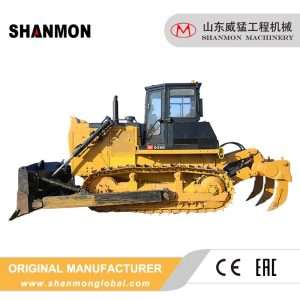
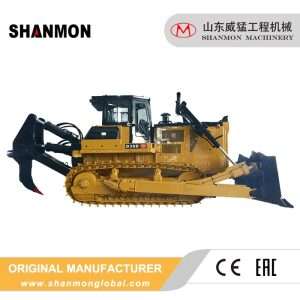
Directed Force: Bulldozers turn engine power into strong forward pushing force. Their wide front blades can push over 10 tons of material. This makes them perfect for leveling large construction project. For heavy duty earthmoving projects, bulldozers work three times faster than loaders.
Precision Grading: Operators control blade tilt—up, down, or sideways—using hydraulic controls. They select U-Blades for greater capacity, S-Blades for precision-level surfaces.
Ripper Enhancement: Rear-mounted rippers fracture compacted soil or weathered rock. Hydraulic shanks penetrate 0.6-1.2 meters deep. They break hard ground into movable material, thereby extending operational limits significantly.
1.2 Loaders: Material Flow Command Centers
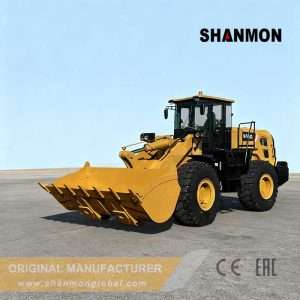
Vertical Work Cycle: Compact wheel loaders focus on digging, lifting, moving, and dumping materials. Their dual-piston arm system creates high dumping curves. Modern loaders can lift loads over 4 meters high—perfect for loading standard dump trucks.
Multi-Tool Agility: Quick-attach systems enable instant implement changes. Options include: 40% larger coal buckets, log grapples, or V-snowplows. This adaptability makes loaders site “Transformers”. Conversely, bulldozers accept under 30% as many attachments.
Cycle Speed: Loader productivity relies on cycle optimization. Shanmon 956 front wheel loader could fill 3.0m³ standard bucket in 8-12 seconds. Therefore, one loader handles 300-400 tons hourly at mine construction sites.

2 Bulldozer vs. Front Loader: Application Scenarios
2.1 Bulldozer Domains
Major Earthworks: Shanmon D26D bulldozer fleets level 80,000m² daily during runway construction according to project requires.
Mining Overburden: Shanmon D36D bulldozer moves 16.2m³ per pass. Combined with rippers, it strips rock 300% faster than excavators.
Disaster Response: Swamp dozers clear mudslides on 35° uneven terrain slopes, creating rescue paths.
Landfill Management: Sanitation models compact 5,000m³ material handling daily using sealed cabs and smooth blades.
2.2 Loader Applications
Bulk Handling: Shanmon 968HEV hybrid loader moves 400tph limestone. Their peak-torque motors deliver 3500Nm instantly, outperforming diesel by 35%.
Modern Farming: Round-bale clamps lift two 1.8m hay bales, working 15x faster than manual labor.
Winter Operations: Front V-plows and rear spreaders enable integrated ice and snow removal.
3 Bulldozer vs. Front Loader: Selection Guide – Four-Step Decision Tree
3.1 Task Priority
What’s your primary objective?
- Reshape terrain → Bulldozer
- Handle materials → Loader
3.2 Distance Check
How far will you be moving materials?
- Under 100m → Bulldozer saves costs
- 100-300m → Loader boosts efficiency
3.3 Ground Conditions
What’s your terrain like?
- Wet/steep/soft → Tracked Bulldozer
- Hard/dry surfaces → Wheeled Loader
3.4 Budget Factors
What’s your budget constraint?
- Higher budget → Bulldozer
- Cost-sensitive → Loader (more versatile)

Conclusion
Both wheel loaders and bulldozers have distinct strengths. Front loaders handle large amounts of materials best, while bulldozers master earthmoving and leveling.
Consider your project needs, terrain, and budget when choosing. This ensures efficient, cost-effective operations. Remember: bulldozers shape land with power, front loaders manage materials with agility.